
Why Smart Companies Are Replacing Fragile Phone Systems with Resilient Cloud Communications
Alpharetta, United States – January 27, 2026 / SIP.US /
Communication resilience determines whether your business survives a crisis or becomes another statistic.
-
Traditional phone systems create dangerous single points of failure that leave companies disconnected during emergencies.
-
SIP trunking business continuity features provide automatic failover, geographic redundancy, and PSTN backup options.
-
Businesses with proper VoIP redundancy maintain customer relationships and revenue streams when competitors go dark.
Every organization needs a disaster recovery communication strategy before the next outage occurs.
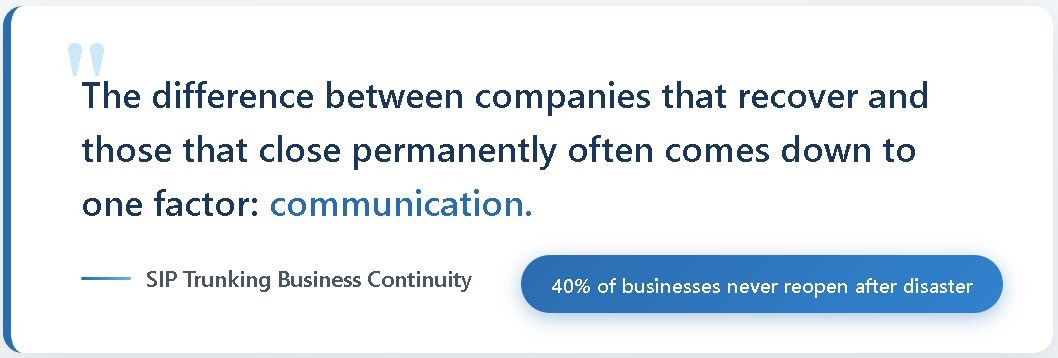
When disaster strikes, the difference between companies that recover and those that close permanently often comes down to one factor: communication. Approximately 40% of businesses never reopen after a major disaster, with an additional 25% failing within one year. While many factors contribute to these failures, the inability to communicate with customers, employees, and vendors during critical moments ranks among the most devastating.
SIP trunking is a powerful solution for organizations seeking reliable business continuity and disaster recovery capabilities. Unlike traditional phone systems that depend on physical infrastructure and single-location hardware, SIP trunking business continuity features leverage internet-based connectivity and distributed architecture to keep communications flowing during natural disasters, cyberattacks, power outages, and other disruptions.
What Makes Traditional Phone Systems Vulnerable During a Crisis?
Traditional phone systems were designed for an era when businesses operated from single locations with stable infrastructure. These legacy systems rely on copper wires, on-premises PBX hardware, and physical connections to the Public Switched Telephone Network. When any component in this chain fails, communications stop entirely.
Consider what happens during a regional power outage. Traditional phone systems housed in your office go offline immediately. Even if backup generators provide temporary power, damaged phone lines or disrupted carrier networks render the equipment useless. Your business becomes unreachable precisely when customers need information most urgently.
The financial consequences of communication downtime have grown. Unplanned downtime costs Global 2000 enterprises approximately $400 billion annually. While these figures impact large enterprises, small and midsize businesses face proportionally severe impacts when communication systems fail. Over 90% of midsize companies report downtime costs exceeding $300,000 per hour.
Beyond direct revenue losses, communication failures damage customer relationships that took years to build. Customers who can’t reach your business during emergencies often find competitors who can serve their needs, and those relationships rarely return after the crisis passes.
How Does SIP Trunking Strengthen Business Continuity?
SIP trunking transforms how businesses approach communication resilience. Rather than depending on vulnerable physical infrastructure, SIP technology delivers voice communications over internet connections using multiple redundant pathways. This architectural difference creates inherent disaster recovery capabilities that traditional systems can’t match.
Geographic Redundancy Eliminates Single Points of Failure
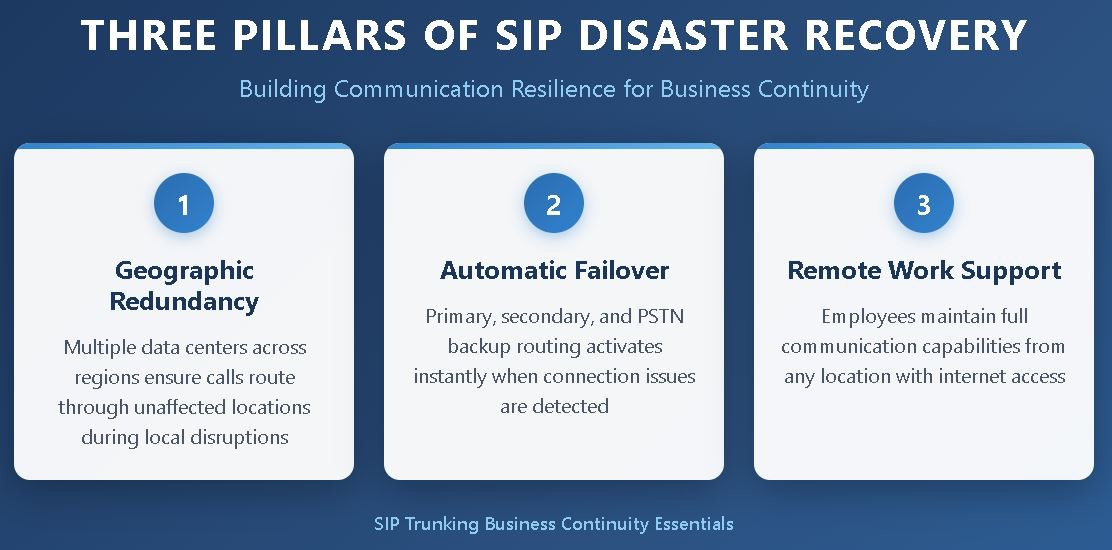
Enterprise-grade SIP providers maintain infrastructure across multiple data centers in different geographic regions. When your business sends or receives calls through SIP trunks, intelligent routing systems direct traffic through the most efficient available pathway. If one data center experiences problems, calls automatically route through unaffected locations without any manual intervention.
This geographic distribution of resources means regional disasters affecting your primary location do not necessarily impact your ability to communicate. Hurricanes devastating the Gulf Coast, earthquakes affecting California, or severe winter storms paralyzing the Northeast cannot disable communication systems distributed across the country. Redundant SIP proxies with DNS SRV capability automatically direct traffic to available servers, ensuring uninterrupted connectivity.
Automatic SIP Failover Keeps Calls Flowing
SIP disaster recovery capabilities extend beyond geographic distribution. Advanced SIP failover systems provide multiple layers of backup routing that instantly activate when primary connections experience issues.
Key SIP failover capabilities include:
-
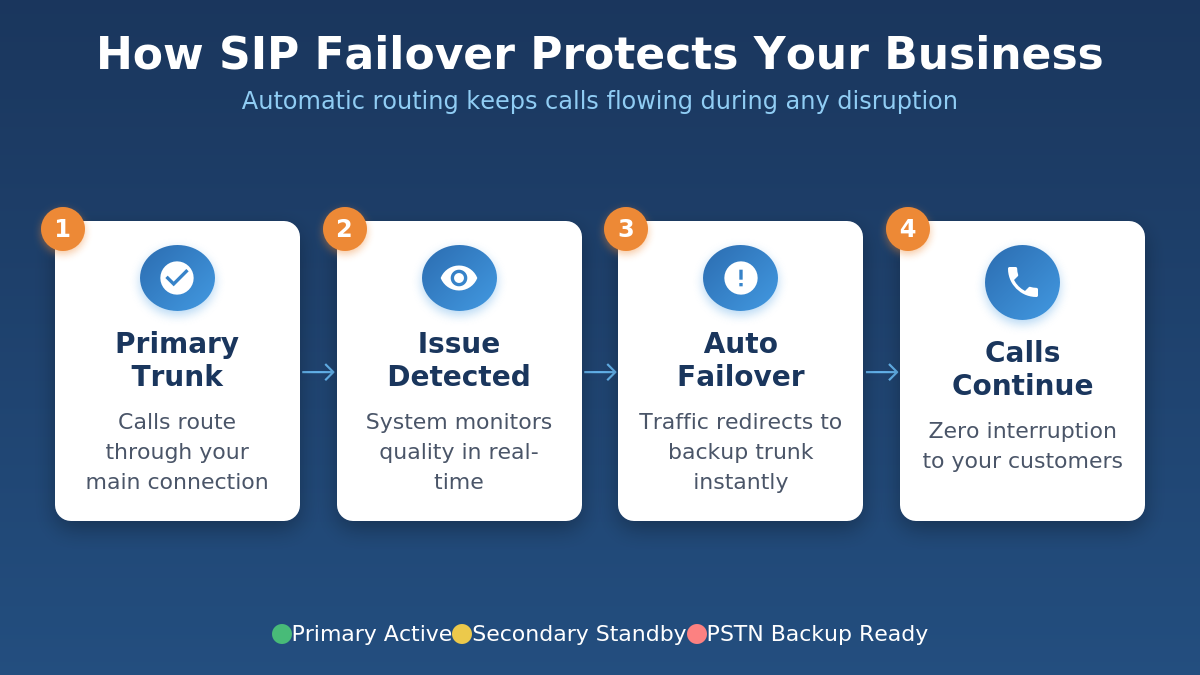
Primary and secondary SIP trunk configurations that automatically switch when problems occur
-
PSTN backup routing that forwards calls to traditional telephone numbers during complete internet outages
-
Call forwarding to mobile devices so employees remain reachable regardless of office status
-
Real-time monitoring that detects connection quality issues and reroutes traffic before customers notice problems
These automatic failover mechanisms consider multiple factors when determining routing decisions, including network latency, packet loss rates, and jitter measurements. The sophisticated analysis ensures calls route through the highest quality available path, maintaining voice quality even during network disruptions.
VoIP Redundancy Supports Remote Teams
Modern business continuity planning must account for distributed workforces. VoIP redundancy through SIP trunking enables employees to maintain full communication capabilities from any location with internet access. During crises that prevent office access, team members can continue serving customers from home, temporary locations, or mobile devices.
This flexibility proved invaluable during recent years as businesses faced unexpected disruptions requiring rapid shifts to remote operations. Organizations with SIP-based communication systems transitioned seamlessly, while those dependent on traditional office phone systems scrambled to establish alternative communication channels.
What SIP Disaster Recovery Features Should You Look For?
Selecting a SIP provider with robust disaster recovery capabilities requires evaluating specific features that determine resilience during actual emergencies.
Tier-1 carrier relationships ensure optimal call quality and reliability. Providers using Tier-1 upstream carriers route traffic through established, well-maintained networks rather than discount carriers that may lack redundancy. Look for providers that explicitly state their carrier relationships and network architecture.
Multiple failover options give you flexibility in how calls route during different failure scenarios. The most comprehensive solutions offer primary trunk, secondary trunk, and PSTN failover capabilities. For each telephone number, you should be able to specify routing preferences that match your business requirements.
Self-service control panels enable rapid response to changing conditions. During emergencies, you need the ability to modify routing rules, activate backup configurations, and monitor system status without waiting for provider support. Intuitive interfaces that allow immediate changes help minimize disruption when problems occur.
Service Level Agreements provide contractual guarantees for uptime and performance. Enterprise-grade providers typically offer 99.9% or higher uptime guarantees with specific remediation procedures when service levels fall below agreed standards. Review SLA terms carefully to understand what commitments your provider makes.
Why Do Small Businesses Need VoIP Redundancy Now?
Small business owners sometimes assume that enterprise-level disaster recovery capabilities exceed their requirements or budgets. This assumption creates dangerous vulnerability gaps that become apparent only during actual emergencies.
The reality is that small businesses face disproportionate impacts from communication failures. Larger organizations may have brand recognition and customer loyalty that survives temporary unreachability. Small businesses depend more heavily on being available when customers need them. A few days of communication downtime can permanently damage customer relationships that represent years of relationship building.
SIP trunking business continuity features have become accessible to organizations of all sizes. Modern providers offer scalable solutions without long-term contracts or significant upfront investments. Businesses can implement enterprise-grade redundancy while paying only for the capacity they actually need.
The question is no longer whether small businesses can afford communication resilience. Given the documented failure rates of businesses following disasters, the question is whether any organization can afford to operate without proper SIP disaster recovery capabilities in place.
Frequently Asked Questions
How quickly does SIP failover activate when a primary connection fails? Automatic SIP failover typically activates within seconds of detecting connection problems. Advanced monitoring systems continuously evaluate connection quality metrics, and intelligent failover mechanisms begin rerouting calls immediately when thresholds are exceeded. Most businesses and their customers never notice the transition between primary and backup routing paths.
Can SIP trunking maintain communications during a complete internet outage? Yes, comprehensive SIP disaster recovery includes PSTN backup routing that forwards calls to traditional telephone numbers when IP-based routing fails completely. This feature ensures critical communications can continue even during total internet outages, providing ultimate redundancy for businesses that can’t afford communication interruptions.
What internet bandwidth do I need for reliable SIP trunking during emergencies? Each concurrent VoIP call typically requires approximately 85–100 kbps of bandwidth. However, disaster recovery planning should account for backup internet connections and sufficient overhead capacity. Some businesses maintain secondary internet providers specifically to ensure VoIP redundancy during primary connection failures.
How does SIP trunking compare to traditional phone systems for business continuity? Traditional phone systems create single points of failure through centralized hardware and physical connection dependencies. SIP trunking distributes communication infrastructure across multiple geographic locations with automatic failover capabilities. During regional disruptions, SIP-based systems can maintain operations while traditional systems dependent on local infrastructure go offline completely.
Build Communication Resilience Before the Next Crisis
Effective disaster recovery planning requires action before emergencies occur. Organizations that wait until experiencing communication failures discover that implementing new systems during crises proves far more difficult and expensive than proactive preparation.
SIP trunking business continuity is the modern standard for organizations serious about operational resilience. The combination of geographic redundancy, automatic SIP failover, and VoIP redundancy creates communication infrastructure that maintains connectivity through scenarios that would completely disable traditional phone systems.
For businesses ready to strengthen their disaster recovery communication strategy, SIP.US provides the redundant infrastructure and automatic failover capabilities that resilient operations require.


Contact Information:
SIP.US
12725 Morris Rd Suite 420
Alpharetta, GA 30004
United States
Mark Amick
https://www.sip.us/
